
Yes, termites fly, but only one kind of termite and only for a few minutes of its life. The winged termites you see are swarmers, young kings and queens that leave a mature colony to start a new one. Workers and soldiers, the termites that eat wood, never grow wings. Around Apache Junction, swarmers usually take off after rain. If they show up inside your house, call (480) 422-8388 for an inspection.

We get this question a lot from homeowners in 85119 and 85120, usually right after a storm rolls off the Superstition Mountains and a cloud of winged insects shows up on the patio light. Most people want to know two things. Was that termites? And does it mean termites are in my house? This guide answers both. It covers which termites fly, when they fly in Pinal County, how to tell a flying termite from a flying ant, and what to do in the first hour after a swarm. When you need it, our termite treatment in Apache Junction picks up where this guide leaves off.
Do All Termites Have Wings?
No. A termite colony has three castes, and only one of them ever flies:
- Workers are soft, pale and wingless. They make up most of the colony, chew the wood and build the mud tubes you see on stem walls and block fences. These are the termites that do the damage.
- Soldiers are also wingless. They have larger, darker heads and strong jaws for guarding the colony from ants.
- Reproductives (alates, or swarmers) are the only termites with wings. They are darker than workers, with fully formed eyes and two pairs of long wings. A colony usually has to be a few years old before it starts producing them.
So when someone asks "do termites fly?", the honest answer is that the colony sends out flyers once in a while. The termites eating a house stay underground or inside the wood the whole time.
Why Do Termites Fly at All?
Flying is how termites start new colonies. Once a year or so, a mature colony releases swarmers, often thousands at once. They flutter up, drift a short distance, land, and break off their own wings. Then a male and female pair up, look for moist soil or wood, and seal themselves in to become the king and queen of a new colony.
Termites are weak fliers. Most swarmers travel only a short distance, often helped by the breeze, and the flight itself is over in minutes. Birds, lizards, ants and the Arizona sun kill the large majority of them before they ever find a place to nest. That is why a swarm does not mean thousands of new colonies. What it does tell you is that a mature colony is close by.
How long do flying termites live?
Not long once they leave the nest. A swarmer that does not find a mate and a moist spot quickly dries out and dies, usually within a day. Indoors, swarmers head for windows and lights and die on the sills. That is why piles of dead termites and loose wings near a window are one of the most common signs we find.
When Do Termites Swarm in Apache Junction?
Timing depends on the species. Rain is the biggest trigger here, because swarmers need damp soil to dig into after they land. These are the patterns we see across the East Valley and Pinal County:
| Termite | How common here | Typical swarm season | Time of day | What you usually notice |
|---|---|---|---|---|
| Desert subterranean termite (Heterotermes aureus) | The most common structural termite in the low desert | Summer monsoon, July into September, after storms | Dusk and after dark | Small pale-yellow to tan swarmers around porch lights and windows on humid evenings |
| Arid-land subterranean termite (Reticulitermes) | Common across Arizona | Late winter and spring, after rain | Daytime, often on warm, sunny days | Dark brown to black swarmers coming out of soil, a stem wall crack or a slab joint |
| Desert or tube-building termites (Gnathamitermes and relatives) | Very common in open desert and yards | After summer rains | Daytime and evening | Swarmers over open ground; mud casings on dead plants and wood mulch rather than on the house |
| Drywood termites | Less common in our area than subterranean termites | Late summer and fall | Often at night, drawn to lights | Swarmers indoors plus tiny, hard, six-sided pellets below wood trim or furniture |
Ranges and dates vary by year and by how much rain falls. The University of Arizona's Cooperative Extension and UC IPM's termite pest note cover these species in more detail. In practice, we hear from Apache Junction homeowners most after the first big monsoon storms of summer and again after winter and spring storms. A swarm in November is less common, but a warm stretch after a fall rain can still set one off.
Is It a Flying Termite or a Flying Ant?
This is the question that matters most, because flying ants are harmless to your house in most cases and flying termites are not. Carpenter ants and several desert ants swarm at the same times of year. Check three things, ideally on an insect you have caught in a zip bag or on a piece of clear tape:
- The waist. A termite's body is thick and straight from front to back. An ant has a pinched, wasp-like waist.
- The antennae. Termite antennae are straight and look like a string of tiny beads. Ant antennae bend in the middle like an elbow.
- The wings. A termite's four wings are all about the same length and stretch well past the end of its body. They fall off easily. An ant's front wings are clearly longer than the back pair.
Our Phoenix guide to termites that look like flying ants has more detail on telling them apart. If you have already found wingless, cream-colored insects, our Mesa guide to what termites look like will help you match them.
Does Seeing Flying Termites Mean My House Is Infested?
Not always, but where you see them tells you a lot.
Swarmers outside, in the yard or on a fence
A swarm coming out of the ground in the yard, a dead mesquite stump, an old railroad tie or a pile of firewood means there is a colony in the yard. That is common in Apache Junction, where many lots back onto open desert near the Superstition Wilderness and the washes that run off it. It does not prove the house is infested. It does mean termites are close, and subterranean termites forage a long way underground. That is a good time to book an inspection.
Swarmers inside the house
Swarmers indoors are a much stronger sign. Swarmers come out where the colony is. If they are emerging from a baseboard, a bathroom floor, a slab crack, a garage stem wall or a window frame, the colony is very likely under or inside the structure. Dead swarmers and shed wings on windowsills, in light fixtures or in spider webs in the garage point the same way. We treat this as a call-us-this-week situation.
Do flying termites bite or hurt people?
No. Swarmers do not bite, sting or carry disease. The only risk is to your house, and that risk comes from the colony that sent them out.
What Should I Do Right After a Termite Swarm?
Swarms look alarming, but you have time to do this right. Termite damage builds over months and years, not hours. Here is what we tell homeowners on the phone:
- Save a few samples. Put several insects and some wings in a zip bag or on clear tape. It makes identification fast and certain.
- Note where they came from. A window, a slab crack, a wall outlet or a garage corner. Take a photo if you can.
- Vacuum up the rest. Swarmers indoors will die on their own. A store-bought aerosol kills the swarmers you can see but does nothing to the colony.
- Leave mud tubes alone. If you find pencil-width mud tubes on the foundation, don't scrape them off before an inspection. They show where termites are traveling.
- Check for moisture. Leaky irrigation, a dripping AC condensate line or a downspout dumping water against the foundation makes the soil there more attractive to termites.
- Book an inspection. A trained inspector can confirm the species, find the entry points and recommend a plan.
Why Are Apache Junction Homes Prone to Termites?
We are based here at 2073 W Houston Ave, so we see the same patterns on job after job, and our post on termite treatment for Goldfield Ranch homes walks through a few of them. A few local conditions keep termite pressure high:
- Open desert on every side. Native termite colonies live in the soil under the creosote and palo verde across Apache Junction, Gold Canyon and the land around Lost Dutchman State Park. New lots and older homes alike sit right next to them.
- Monsoon storms off the Superstitions. Summer storms soak the ground in a hurry. That is exactly the cue desert subterranean termites wait for.
- A wide mix of housing. Older site-built homes, manufactured homes, and newer builds along the Apache Trail and in the Superstition Foothills each have their own weak spots, from wood skirting and stem walls to slab joints and plumbing penetrations.
- Wood in contact with soil. Fence posts, landscape timbers, wood mulch and stacked firewood give foraging termites an easy food source near the house.
How Do We Treat Termites After a Swarm?
Killing swarmers is not the goal. The goal is to protect the house from the colony that produced them. After an inspection, we recommend one of two proven approaches, or both together:
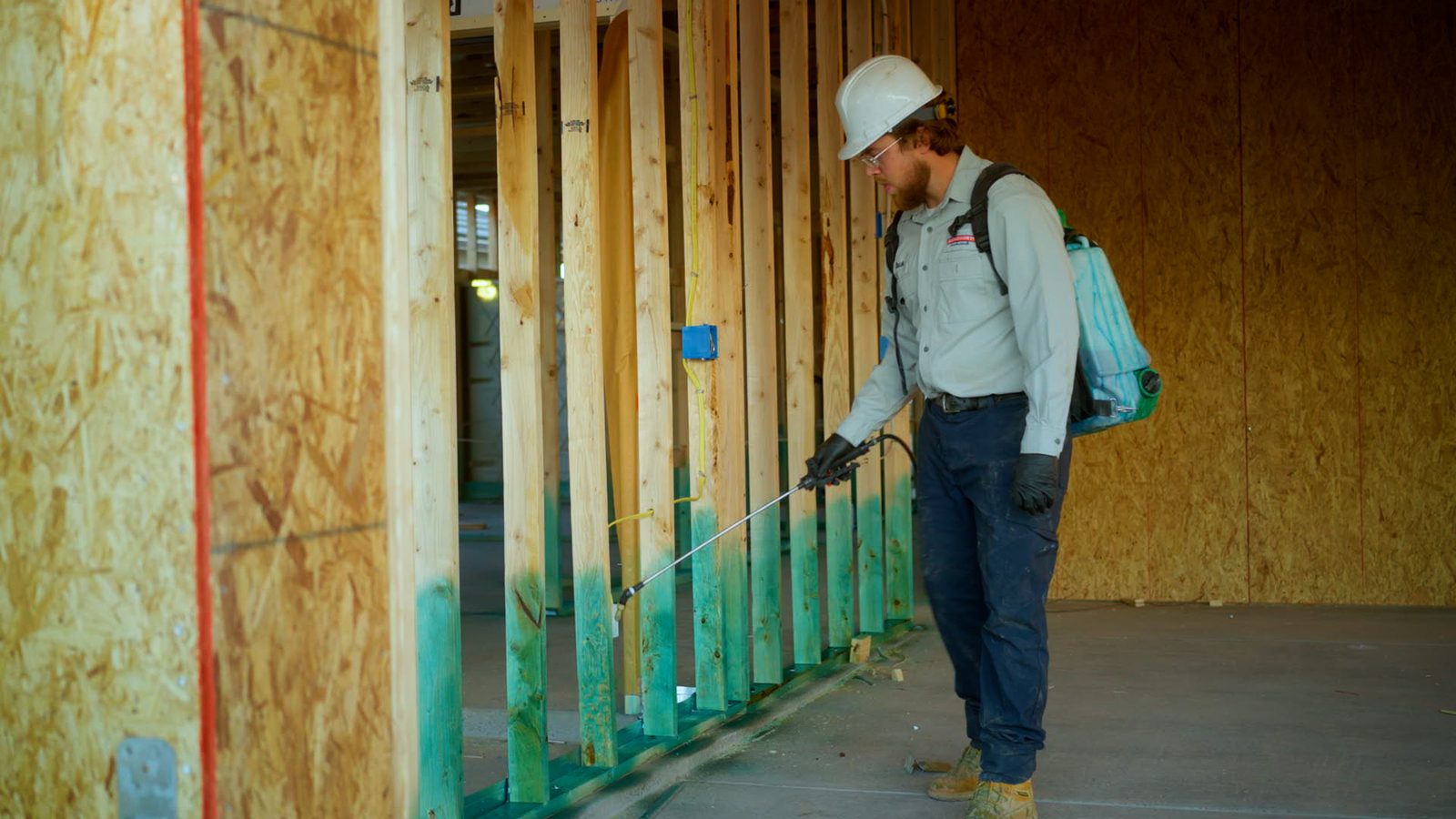
- Liquid soil treatment. We apply a non-repellent termiticide (Termidor) into the soil along the foundation and at key entry points. Termites that pass through it pick it up and carry it back to the colony.
- Baiting. Sentricon bait stations go in the soil around the home. Foraging workers find the bait and share it through the colony.
Every treatment includes a warranty and an annual re-inspection. If you bought a new build and the builder used us for the pre-construction treatment, register your warranty so the coverage stays active. You can see the full process on our Apache Junction pest control page, where termite work sits alongside our scorpion and rodent programs.
Do you serve nearby communities too?
Yes. The same swarm seasons and species run across the eastern edge of the Valley. We do termite control in Gold Canyon, termite treatment in San Tan Valley, termite treatment in Queen Creek and termite treatment in Mesa. Farther south, our pest control in Florence covers Anthem at Merrill Ranch and Magic Ranch. For a deeper look at treatment choices, read our Avondale guide on how to get rid of subterranean termites.
Frequently Asked Questions About Flying Termites
Do termites fly at night?
Some do. In our area, desert subterranean termites usually swarm around dusk and after dark during the monsoon, and drywood termites often fly at night toward lights. Arid-land subterranean termites tend to swarm during the day in late winter and spring.
Why do flying termites come to lights?
Swarmers are drawn to light, which normally helps them leave the nest and get into open air. Indoors, it pulls them to windows, lamps and light fixtures, where they usually die. Turning off porch lights on muggy monsoon evenings cuts down how many end up around your doors.
How long does a termite swarm last?
The flight itself is usually over within an hour, and often much faster. A colony can release more than one swarm over several days or weeks of the season, so seeing a second wave does not mean a second colony.
Can flying termites damage furniture?
Swarmers don't eat wood. Workers do the damage. Drywood termites can live inside furniture and trim, though, and swarmers coming out of a piece of wood furniture along with small pellets is a sign of drywood termites in that piece.
Will termite swarmers go away on their own?
The swarmers will. They die within hours to a day if they cannot find soil or wood. The colony that sent them out does not go away, which is why an inspection matters more than cleanup.
How do I get a termite inspection in Apache Junction?
Call our Phoenix-area team at (480) 422-8388 or request service online. Bring your saved samples or photos, and tell us where the swarmers came from. That helps us check the right areas first.